
Descripción del producto
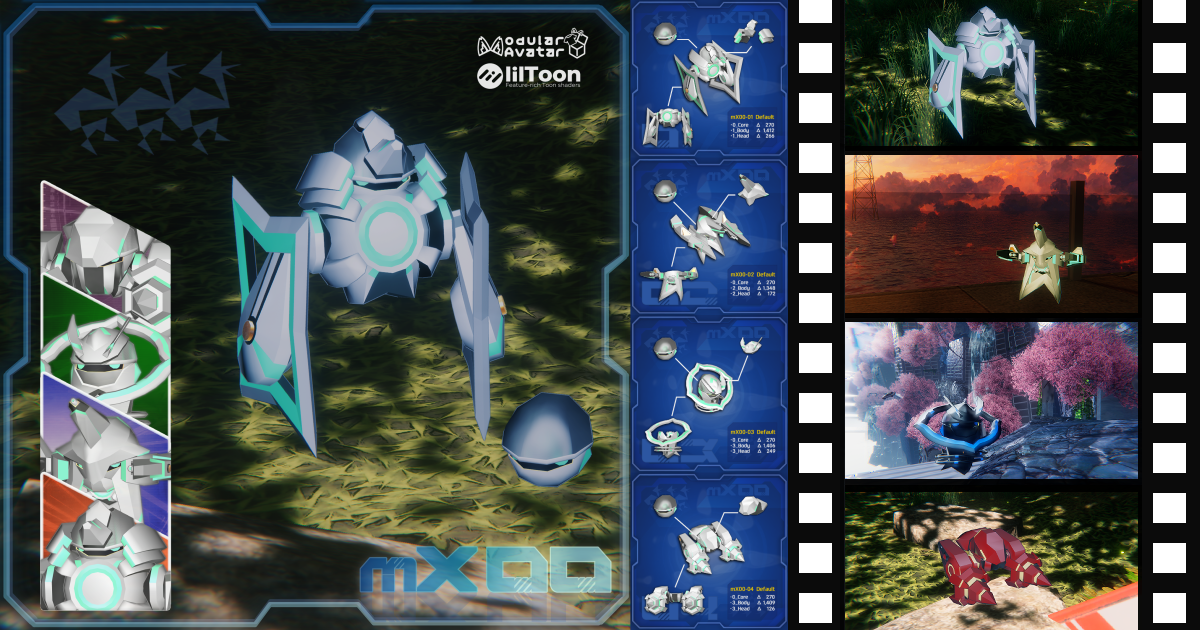
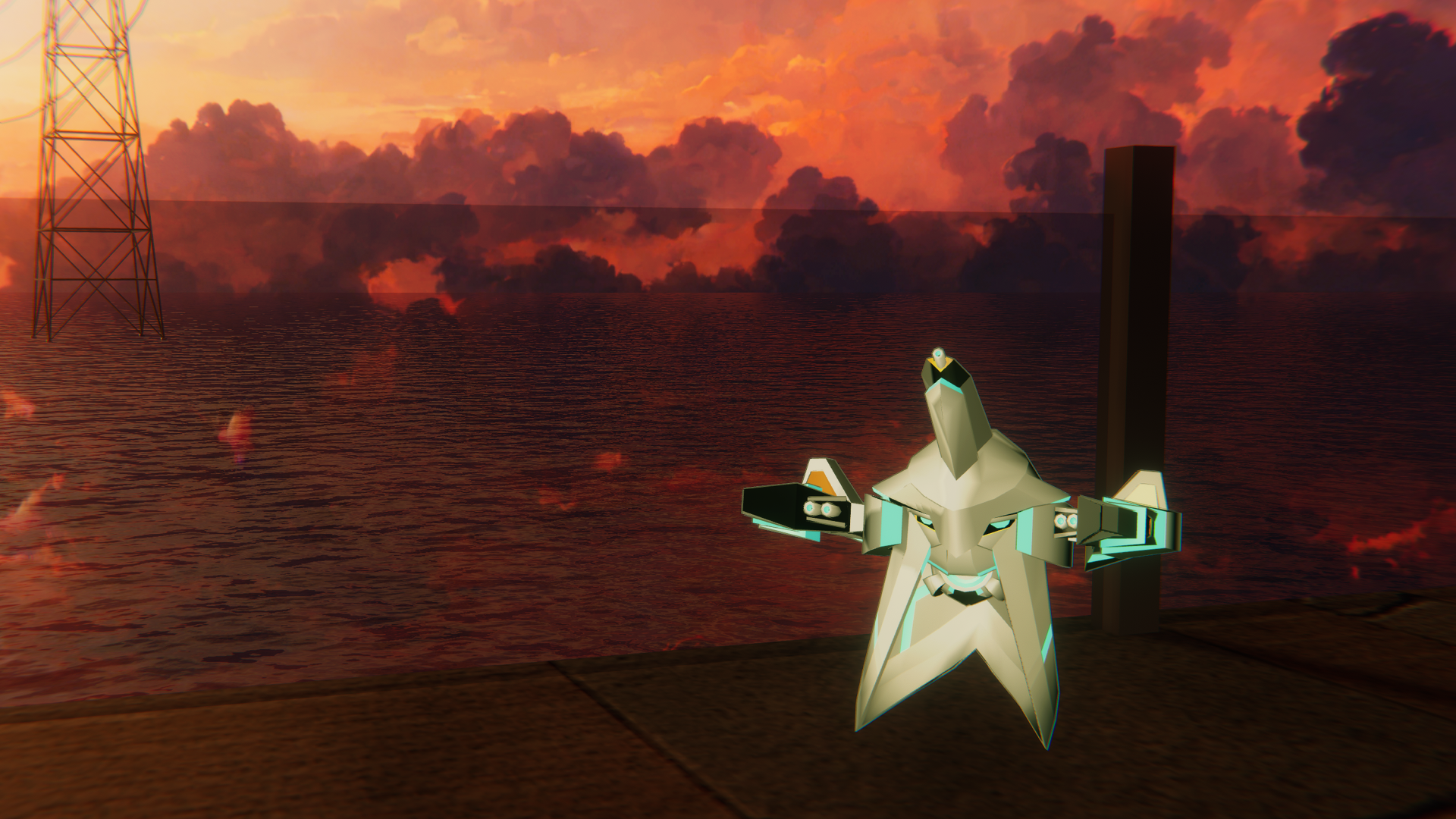
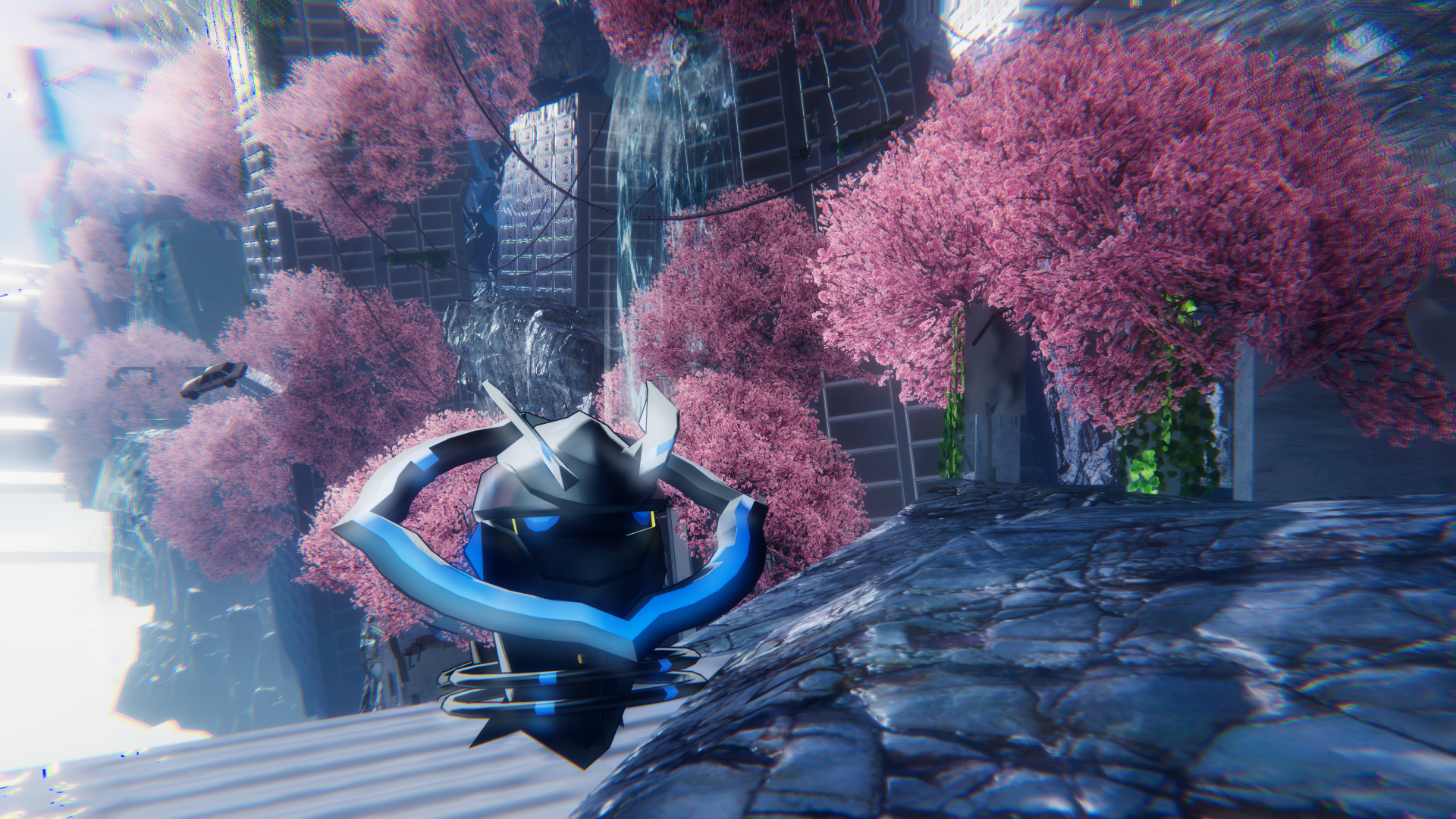
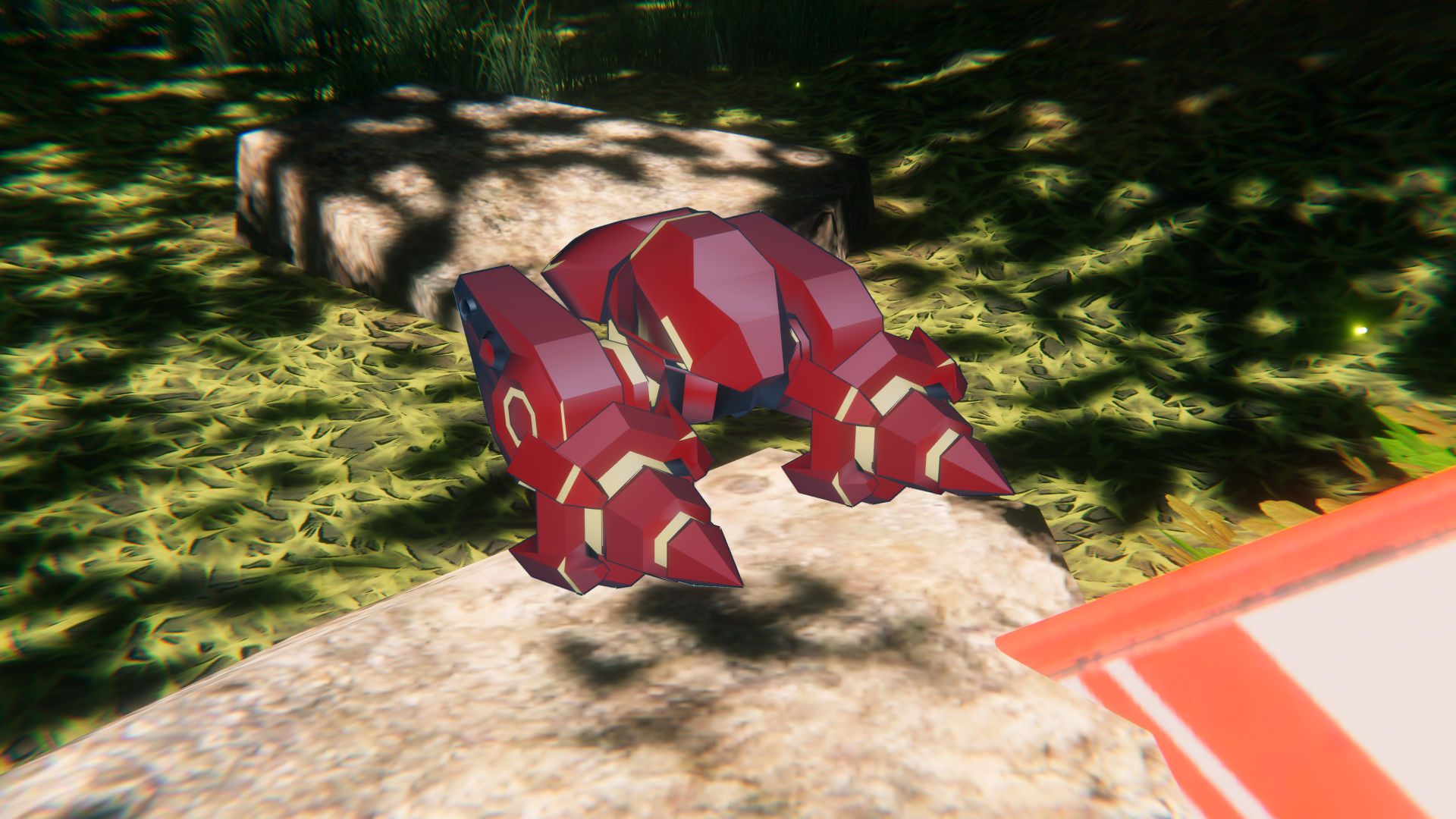
This is a humanoid avatar designed for use in VRChat.
From the Expression menu, you can enable or switch between the pose, control your avatar's gaze, and change outfits and other items.
Recommended tags: #RLB #mX00
Sample Avatars:
https://vrchat.com/home/avatar/avtr_bfa18323-872c-47c5-9518-c8c85d6eb241
--------------------------------------
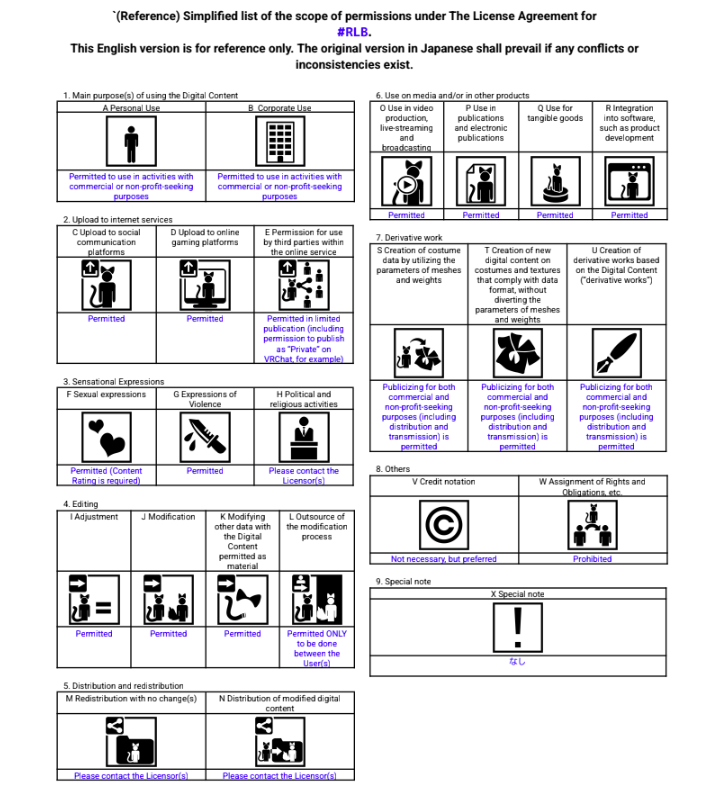
Terms of Use
The VN3 license applies. Please review the details below.
https://drive.google.com/drive/folders/16I1aljgYDT2t7EL_5RhJ0Uio_yVPEGOM?usp=drive_link
 --------------------------------------
Test Environment
- VRChat Creator Companion 2.4.5
- VRChatSDK 3.10.5
- Unity2022.3.22f1
- lilToon 2.3.4
- Avatar Optimizer 1.9.19
- Modular Avatar 1.18.7
--------------------------------------
Avatar Details
Items requiring prior installation (Please import these before installing this product.)
If issues occur after the update, please delete the previous version’s FBX and Prefab files and then re-import them.
- lilToon(Shader)
https://lilxyzw.github.io/lilToon/ - Avatar Optimizer
https://vpm.anatawa12.com/avatar-optimizer/en/ - Modular Avatar
https://modular-avatar.nadena.dev/
- mX00_Avatar.unitypackage
Asset> relybird> mx00> Prefab_Avatar> Prefab
∟ PerformanceRank: Poor
∟ Triangles: △6,658
∟ Download Size: 0.8MB
∟ Skinned Meshes: 9
∟ Material Slot: 10
∟ View Position: 0.71m
∟ Mobile: VeryPoor/Poor
- Skinnd Mesh(Triangles)
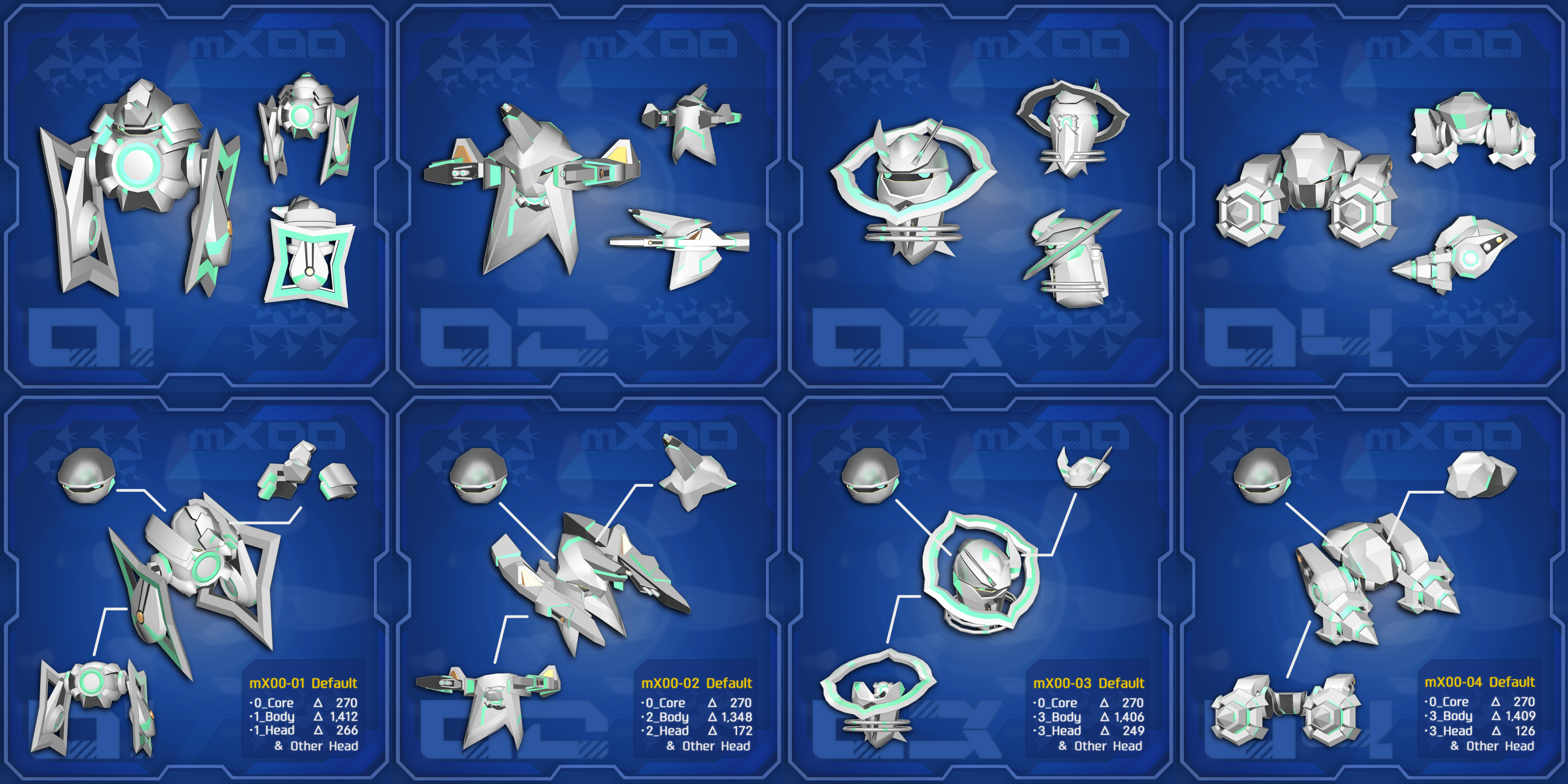
∟ 0_Core(△270)
∟ 1_Body(△1,412)
∟ 1_Head(△266)
∟ 2_Body(△1,348)
∟ 2_Head(△172)
∟ 3_Body(△1,406)
∟ 3_Head(△249)
∟ 4_Body(△1,409)
∟ 4_Head(△126)
--------------------------------------
Important Notes
- EXmenu via MA Menu Installer
- To delete a menu, select the relevant object (■■_Menu or EXmenu_MA) from the History, uncheck the “Enabled” box for the MA Menu Item, or set it to “EditorOnly” or delete the object.
- Full-Body Tracking - Tested with up to 6 tracking points.Performance is not guaranteed in all environments.
- Textures
- Some textures (such as Matcap) are shared with other products in the shop; please be careful not to overwrite them when importing.
--------------------------------------
Credits
- HeightChanger|高さと視点を調整(既存の移動モーションや姿勢を維持します)
https://childwitch.booth.pm/items/6355003
--------------------------------------
Worldview
◆ BASIC CONFIGURATION
This machine is a modular autonomous mobile unit whose primary body is the Core Unit, corresponding to the facial section.
Its capabilities can be expanded by connecting Support Units designed for specific purposes.
The Core Unit contains all central functions required for the machine to exist as an individual entity, including thought, memory, judgment, perception, self-identification, basic communications, and energy management.
In contrast, the body, arms, armor, thrusters, weapons, capacitors, and various support systems are all replaceable external mechanisms.
The primary Support Units currently confirmed are as follows:
01: Close-Range Balanced Type
02: Long-Range High-Speed Type
03: Support-Specialized Type
04: Close-Range Defense-Specialized Type
These forms are created by connecting Support Units with different purposes to Core Units of the same standardized specification.
The Support Unit standard itself is not limited to the four types listed above, and multiple Support Units designed for other purposes also exist beyond Types 01–04.
◆ UNIT STRUCTURE
The machine's structure can be divided into the following three systems:
・The Core Unit, which serves as the main body
・Replaceable Head Parts connected directly to the Core
・Support Units integrating the remaining mechanisms that form the body
Only the Head Parts are standardized across Types 01–04, allowing them to be easily interchanged between different configurations.
By contrast, the body, thrusters, weapons, and other components of each Support Unit are optimized for their intended purpose, including weight, center of gravity, energy routing, heat dissipation, and range of motion.
For this reason, transferring individual components between different Support Unit configurations is not assumed under normal operating conditions.
◆ CORE UNIT
The Core Unit is a single self-contained component containing the machine's central systems.
It houses the central AI, memory storage, communications systems, various control systems, energy management systems, basic sensors, and other essential functions.
The fundamental mechanical performance of all Core Units is standardized, and there are generally no major performance differences such as one particular Core possessing exceptionally high output.
However, even when using the same body, individual differences can appear in areas such as judgment and behavior.
It is currently unclear how each Core develops its standards for decision-making,
or whether the Core is entirely artificial intelligence or originates from some other source.
◆ INDEPENDENT CORE OPERATION
Even with all Support Units removed, the Core Unit is capable of autonomous activity on its own.
It retains the minimum capabilities required for environmental awareness, communication, and movement between Support Units.
If a Support Unit suffers critical damage, the Core can also abandon the damaged section and perform an emergency disengagement independently.
◆ CORE-INTEGRATED THRUSTER
The Core is equipped with a small Ring Thruster.
Its basic performance is equivalent to the small thrusters used by Support Units.
Because the Core Unit itself is extremely lightweight, this small thruster alone is sufficient to provide effective mobility.
It is primarily used for emergency disengagement, reconnaissance, movement through confined spaces, and transfer between Support Units.
◆ CORE ENERGY
The energy used by the Core is based on biological energy.
The exact principle by which this energy is generated remains under investigation.
This energy is used through the Core's integrated thruster. When connected to a Support Unit, it is also supplied throughout the entire unit via the Support Unit's built-in thruster.
If the Core completely loses its energy and all external supply is cut off, this is effectively equivalent to the permanent cessation of Core functionality.
◆ ENERGY SUPPLY SYSTEM
When a Support Unit is connected, energy flows through the following route:
Core → Ring Thruster → Capacitor / Energy Storage System → Individual Systems
The Ring Thruster acts as a central component of the energy system, converting and relaying energy received from the Core into a usable state before distributing it to capacitors and other storage systems.
Energy routed through the thruster is stored in capacitors and other storage mechanisms,
then supplied to weapons, arms, sensors, and other equipment.
Because of this structure, every Support Unit requires a Ring Thruster regardless of its intended role.
◆ ENERGY LINES
Part of the energy transmission network carrying energy from the thruster to the various systems is externally visible in the form of Energy Lines.
Their emitted color is not fixed to the Support Unit, but instead varies depending on the connected Core.
Even when the same Support Unit is used by a different Core, only the Energy Lines change to the unique color associated with that Core.
No identifiable pattern governing these colors has been confirmed.
The Energy Lines also glow more intensely when carrying larger amounts of energy than under normal conditions.
Under abnormal loads exceeding design limits, their light may become unstable.
◆ EXTERNAL BIDIRECTIONAL CHARGING PORTS
Each Support Unit is equipped with standardized External Bidirectional Charging Ports capable of connecting directly to capacitors or weapon systems.
These are primarily used for emergency measures, maintenance, auxiliary charging while on standby, and similar purposes.
All Support Units use the same connector standard.
Under normal conditions, the Support Unit accesses its systems through the Energy Lines supplied by the Core.
When using an External Bidirectional Charging Port, however, direct access to the capacitor system is possible.
For a Support Unit without a connected Core, energy can be supplied from the capacitors to the thruster.
This allows the Support Unit's capacitors and thruster to be prepared in advance and placed into an operational state.
Because the system is bidirectional, it can not only receive external power but also supply energy stored within the unit to external equipment through the connected device.
Port locations are as follows:
01: Both arms: 2 ports total (capacitor system)
02: Both machine guns: 2 ports total (weapon system)
03: Front of support equipment: 4 ports total (power supply equipment)
04: Both shoulders: 4 ports total (capacitor system)
◆ AUTOMATIC OPERATION WITHOUT A CORE
If sufficient energy remains stored in the thruster and capacitors, a Support Unit can continue operating for a limited period even without a Core connected.
However, because it cannot perform normal autonomous decision-making, its actions must be configured in advance.
This allows limited automatic operation such as moving to a designated location, remaining on standby, or performing simple tasks.
◆ CORE AUTHENTICATION
Support Units are equipped with Core authentication systems.
Under normal conditions, their systems fully activate only when an authorized Core is connected.
Because the interface standard itself is shared, a Support Unit assigned to another individual can also be used, provided that the required authentication process is completed.
However, confirmed cases also exist in which authentication was bypassed through unauthorized means, allowing an unauthenticated Core to forcibly connect to a Support Unit.
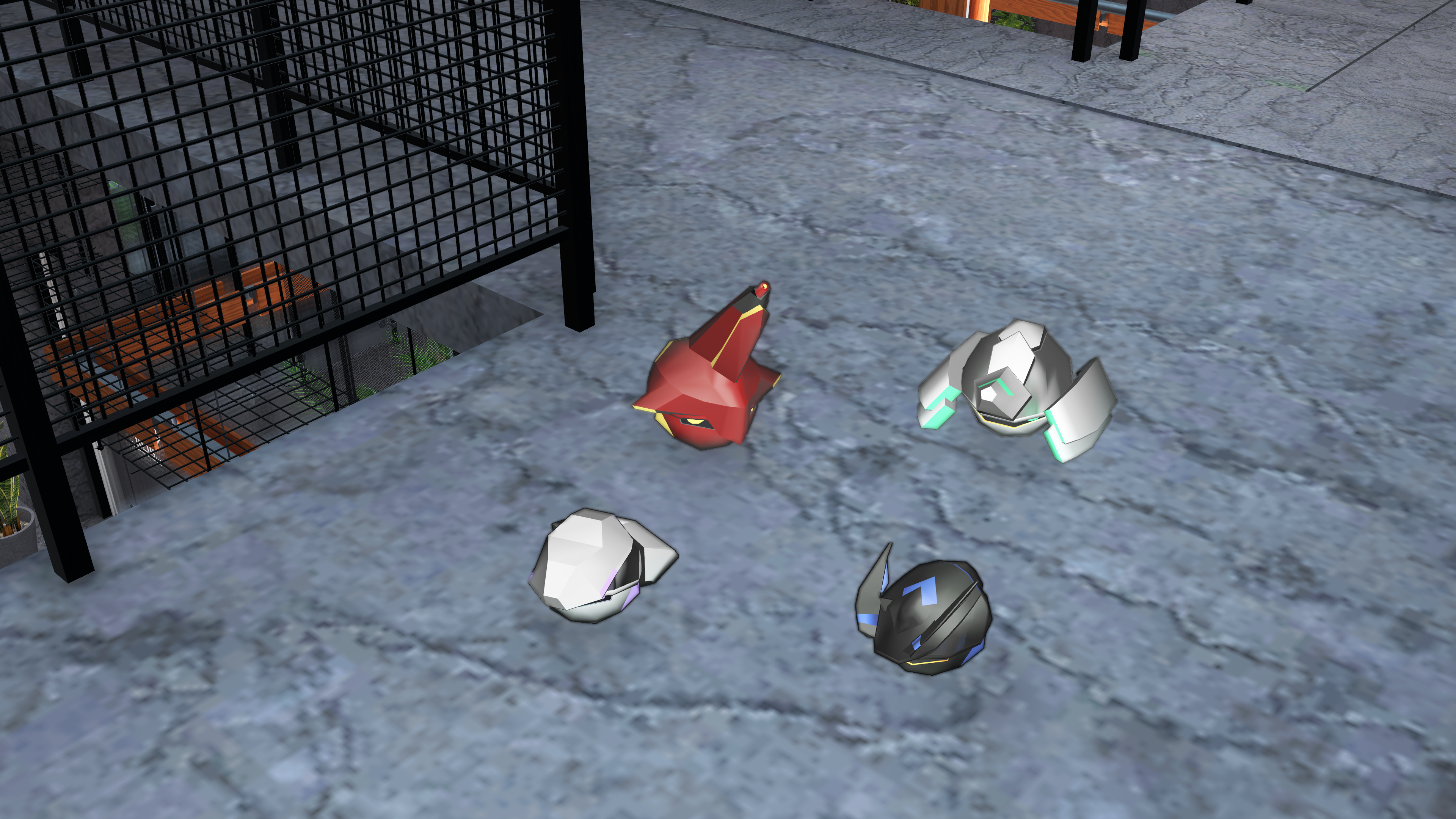
◆ HEAD PARTS
Expansion components connected directly to the Core Unit.
All Head Parts use the same connection standard and can therefore be interchanged between different configurations.
Under standard conditions, each Head Part is used together with the corresponding Support Unit family, although hybrid configurations using Head Parts from other types are also possible.
The Core can also operate with only a Head Part attached and no Support Unit.
01 HEAD
A standard Head Part without large specialized equipment or independent weapons.
Its close-combat capability depends entirely on the Support Unit, so it possesses no direct combat capability when operating only as a Head.
However, it can function as armor protecting the Core.
02 HEAD
Equipped with the main body of a long-range sniper weapon.
It also contains precision-fire sensors used for functions such as aim correction and target tracking, making it somewhat larger than the 01 and 03 Heads.
Because the sniper weapon itself is integrated into the Head, a Core equipped with the 02 Head can operate as a compact mobile sniper unit.
03 HEAD
Equipped with antennas, communications equipment, detection sensors, and related systems.
Because these systems can be operated by the Head itself, a Core equipped with the 03 Head can perform communications, reconnaissance, and information relay functions.
However, charging equipment, barriers, recovery systems, and other functions dependent on the Support Unit cannot be used.
04 HEAD
A Head Part designed primarily to serve as armor.
Its armor extends not only across the front but also around the rear of the Core, protecting a wider area.
Its close-combat capability depends on the Support Unit, so it has no direct combat capability in Head-only configuration.
It is primarily used as heavy armor.
◆ BASIC CONFIGURATIONS
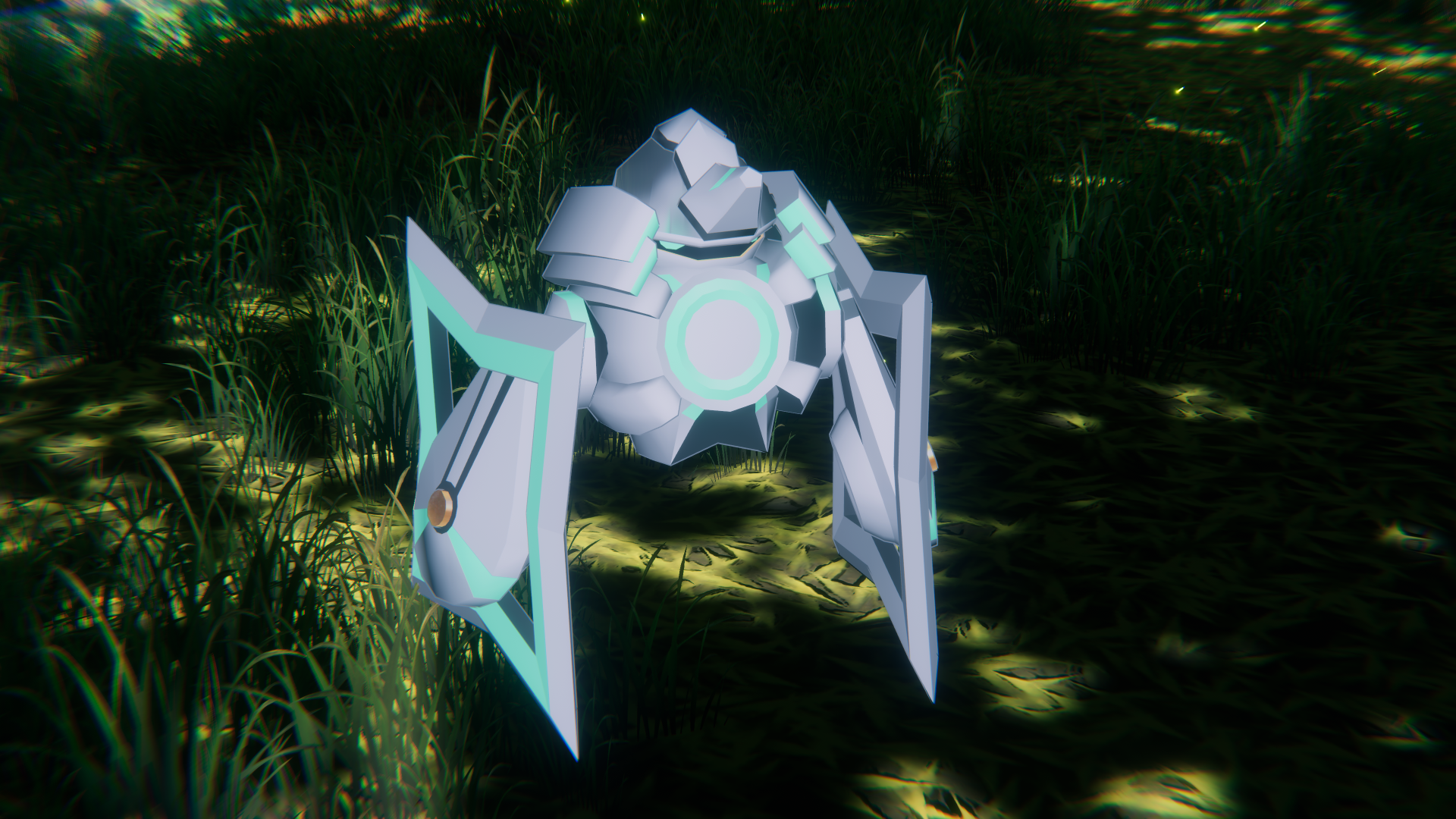
◇ 01 | CLOSE-RANGE BALANCED TYPE
A close-range balanced unit combining a large Ring Thruster, medium-weight armor, and arms equipped with capacitors.
It is a highly versatile configuration without an extreme bias toward offense, defense, or mobility.
Large Ring Thruster
The large thruster mounted at the center of the unit excels at short bursts of extremely high output, but also generates substantial heat.
Heat dissipation is therefore prioritized, and most of the thruster is mounted almost completely exposed at the center of the machine.
The large thruster allows the entire unit to accelerate rapidly in a single burst.
Arm Capacitors
Capacitors are installed in both arms.
Stored energy is supplied to close-range weapons and the arms themselves, where it is used for attacks, posture stabilization, resistance to impacts, and other functions.
Two External Bidirectional Charging Ports are located on the arms.
Characteristics
This configuration combines rapid acceleration from its large thruster with strong close-combat capability.
However, prolonged continuous use at high output can overwhelm its heat dissipation capacity.
Among the four standard configurations, it offers the highest overall versatility and is treated as the standard combat configuration.
◇ 02 | LONG-RANGE HIGH-SPEED TYPE
A long-range high-speed unit combining a lightweight body, small Ring Thruster, Sniper Head, and machine guns mounted on both arms.
Rather than using large capacitors, the unit reduces armor and equipment to lower its overall mass and achieve high mobility.
Small Ring Thruster
Because the unit itself is lightweight, a single small thruster provides sufficient mobility.
Taking advantage of its compact size, the thruster is installed partially embedded within the body.
Lightweight Armor
The unit is designed around avoiding incoming attacks entirely.
Its body armor is therefore reduced to the minimum necessary level in order to minimize weight.
Weapons
The standard configuration uses the sniper weapon built into the 02 Head together with machine guns mounted on both arms.
The sniper weapon is used against long-range targets.
If enemies close the distance, the machine guns are used for suppressive fire while the unit re-establishes range.
The energy storage devices integrated into the weapon systems are also used as capacitors for practical purposes, meaning the unit does not carry separate dedicated capacitors.
Two External Bidirectional Charging Ports are installed on the left and right machine guns.
◇ 03 | SUPPORT-SPECIALIZED TYPE
A specialized Support Unit responsible for resupply, communications, reconnaissance, recovery, and defensive support.
Its most distinctive structural feature is that many areas used as armor on other configurations are replaced with charging systems, sensors, and other support equipment.
Support Equipment
Various sections of the unit are equipped with charging and power-supply systems, sensors, communications equipment, vital recovery systems, barrier generators, and other support mechanisms.
Small Ring Thruster
The small Ring Thruster is installed embedded into the rear of the charging equipment.
Rather than prioritizing high-speed movement, it emphasizes stability and energy efficiency.
It is also used as an energy relay for the unit's support systems.
Four External Bidirectional Charging Ports are located on the front of the support equipment and can be used to transfer energy to and from other units.
Barrier Generator
The barrier system can be used to provide defensive support to nearby units.
However, it requires substantial weight, internal volume, and energy consumption.
Although the unit has low direct combat capability and limited armor protection, it is highly specialized for improving sustained operational capability.
◇ 04 | CLOSE-RANGE DEFENSE-SPECIALIZED TYPE
A close-range defense-specialized unit combining heavy armor, a medium Ring Thruster, and multiple large capacitors.
Its design prioritizes maintaining position while directly absorbing enemy attacks.
Medium Ring Thruster
The thruster is mounted facing downward beneath the unit.
The thruster itself remains exposed for heat dissipation, but the surrounding structure consists of heavy armor.
It can also be used for weight support, posture stabilization, reverse thrust, and similar functions.
Arm Capacitors
The standard configuration carries four large capacitors in total: two in the shoulders and two on the arms.
The arm-mounted capacitors are integrated into the weapon systems and provide high-output energy to both the weapons and arm mechanisms.
The shoulder-mounted capacitors assist in maintaining a stable energy supply throughout the entire unit.
Four External Bidirectional Charging Ports are installed in total.
They are primarily used for emergency charging, maintenance, and other operations involving the capacitor-centered energy system.
◆ CAPACITORS
Large energy-storage mechanisms installed in Support Units.
All use a common standardized design.
Their total capacity and the amount of energy they can handle vary depending on their size and the number installed.
Each Support Unit adjusts the size, quantity, and placement of its capacitors according to its required performance.
Type 02 is the sole exception, carrying no independent capacitors and instead using the energy-storage mechanisms integrated into its weapon systems.
◆ LIGHT CONFIGURATIONS
Each Support Unit also has a Light Configuration in which large-scale equipment has been removed.
In general, this refers to an operating configuration that retains the armor and thruster while removing the weapon systems.
◇ 01 LIGHT CONFIGURATION
The close-range weapons are removed.
The large thruster and standard armor remain intact.
In exchange for reduced offensive capability, the configuration emphasizes mobility and protective functions.
◇ 02 LIGHT CONFIGURATION
The machine gun systems are removed.
As a result, the integrated energy-storage systems and External Bidirectional Charging Ports are also lost.
When used with the 02 Head, the unit retains its sniper capability, producing an even lighter configuration optimized for sniping and reconnaissance.
◇ 03 LIGHT CONFIGURATION
The large barrier generator is removed.
The charging equipment, sensors, communications systems, antennas, vital recovery systems, and small thruster remain intact.
In exchange for losing defensive support capability, the reduced weight and energy consumption make this configuration suitable for extended-duration operations.
◇ 04 LIGHT CONFIGURATION
The close-range weapons are removed.
Because some capacitors are integrated into the weapon systems, two capacitors are also removed.
The heavy armor and medium thruster remain intact, making this configuration suitable for operations where reduced offensive capability and energy storage capacity are acceptable.
◆ RING THRUSTERS
Ring Thrusters are available in large, medium, and small sizes.
Large Thruster (01): Excels at burst output and enables rapid acceleration. However, it has high energy consumption and produces substantial heat.
Medium Thruster (04): Produces less output than the large type but offers superior stability, making it suitable for sustained operation.
Small Thruster (02 / 03): Lower in absolute output, but lightweight, energy-efficient, and easy to operate. It also performs effectively as an energy relay for charging systems.
Because the Ring Thruster also functions as an energy relay, complete destruction of the thruster stops the Core's energy supply to the entire Support Unit.
However, because the capacitors retain a certain amount of stored energy, the unit can temporarily transition to capacitor-powered operation following thruster failure.
Once the capacitor reserves are exhausted, the Support Unit becomes essentially inoperable.
If only the charging circuit is damaged, operation can still be maintained by supplying energy through an External Bidirectional Charging Port directly into the capacitor system.
In addition, even after the Core has ceased functioning, a Support Unit can be remotely operated by another machine as long as energy remains stored in its thruster or capacitors.
◆ REPAIRS AND PARTS SALVAGE
Repair procedures for Support Units vary depending on the damaged section.
Major components optimized specifically for each configuration—such as the body structure, dedicated weapons, and thrusters—require the corresponding replacement parts.
However, components manufactured to shared specifications, such as sensors and external connector parts, can be salvaged from Support Units assigned to other Cores in the event of damage or emergency.
◆ DEVELOPMENT LINEAGE
Before the current generation of Support Units, an older-generation prototype machine existed as the basis for development.
The present standard was developed from this earlier-generation platform.
Type 01 is a direct successor that updates the individual systems of the older-generation machine while retaining its general-purpose versatility.
Types 02, 03, and 04, by contrast, were developed as specialized configurations that significantly expand upon particular capabilities of the older-generation design.
◆ CUSTOM CONFIGURATIONS
Normally, the body, thruster, and weapons are designed as an integrated system tailored to each Support Unit.
However, by modifying the machine itself, it is possible to create custom configurations that operate outside these standard limitations.
For example, a machine could retain a large thruster while simultaneously mounting both close-range and long-range weapons, combining capabilities that are separated between different standard configurations.
Non-standard machines that remain within an acceptable safety range are generally classified as Custom configurations.
However, they are not guaranteed to provide the same level of stability as officially designed configurations.
◆ OVER-SPEC CONFIGURATIONS
Configurations that demand output beyond the safety limits established for a Support Unit are classified separately as Over-Spec configurations.
Confirmed examples include configurations that simultaneously operate large thrusters, high-output weapons, and long-range weapons beyond the system's normal safe operating limits.
Such configurations can temporarily achieve performance far exceeding standard specifications, but place extreme stress on every part of the energy pathway and are highly dangerous.
They may cause Energy Line damage, equipment malfunctions, or structural failure of the frame and connection points.
Under overload conditions, the Energy Lines may begin emitting abnormal levels of light.
At still higher loads, heat dissipation can become insufficient, causing the armor itself to glow red-hot.
Ultimately, there is a risk of damage extending to the Core Unit itself.